

Real-time visibility into enrollment and site and depot inventory enables resupply logic to adjust, with reporting embedded alongside patient assignment to preserve dosing continuity while controlling excess inventory and exposure.
Services Delivery
Services Delivery
Delivery Aligned to How Sponsors Operate
Study requirements rarely arrive fully formed. Protocol interpretation, supply strategy, visit design, integrations, and forecasting assumptions sharpen as teams review real operational needs.
Iterative study design is built into the delivery model, supporting structured iteration so configuration remains aligned to protocol intent as requirements evolve. Roles are clearly defined, and specialist coverage remains consistent from build through study maintenance and closeout.
Study Lifecycle Support
Each study follows a structured lifecycle with clearly assigned ownership, documented controls, and formal review points. Process discipline reduces downstream disruption.
Configuration is developed around how the study is intended to operate, not just how requirements appear at the outset.
Randomization, supply, forecasting, visits, and integrations are designed together to reduce downstream rework and support stronger decisions earlier.
Sponsors gain early visibility into study configuration through controlled environments, defined standards, and version governance.
Sandbox access helps teams identify refinements before formal validation begins, reducing late stage redesign.
Go-live is approached as an operational readiness milestone, with readiness reviews across randomization, resupply, integrations, reporting, and escalation pathways.
This helps teams enter enrollment with stronger alignment, clearer ownership, and greater launch confidence.
Dedicated delivery resources remain engaged beyond go-live, with clear responsibilities and consistent ownership as the study moves into live execution.
Approved updates follow controlled pathways that protect randomization integrity, resupply behavior, and supply continuity.
-
Study Design
-
Configuration is developed around how the study is intended to operate, not just how requirements appear at the outset.
Randomization, supply, forecasting, visits, and integrations are designed together to reduce downstream rework and support stronger decisions earlier.
-
Early System Visibility
-
Sponsors gain early visibility into study configuration through controlled environments, defined standards, and version governance.
Sandbox access helps teams identify refinements before formal validation begins, reducing late stage redesign.
-
Go-Live Readiness
-
Go-live is approached as an operational readiness milestone, with readiness reviews across randomization, resupply, integrations, reporting, and escalation pathways.
This helps teams enter enrollment with stronger alignment, clearer ownership, and greater launch confidence.
-
Maintenance Support
-
Dedicated delivery resources remain engaged beyond go-live, with clear responsibilities and consistent ownership as the study moves into live execution.
Approved updates follow controlled pathways that protect randomization integrity, resupply behavior, and supply continuity.
Let the Science Lead
Design around protocol requirements, not technology system limitations. Guided by RTSM and supply expertise, this iterative build process helps sponsors refine and strengthen system design as protocol requirements, supply strategy, and operational requirements take shape.
.png?width=2000&height=833&name=4G_Loop_Graphic_2026_Update%20(3).png "4G_Loop_Graphic_2026_Update (3)")
Operational Capabilities Across Randomization and Supply
Stable execution requires more than configuration. 4G Clinical combines protocol fluency, real-world RTSM and clinical supply expertise, and live oversight to keep patient dosing, supply movement, and study execution stable through amendments and change.
-
Randomization and Patient Allocation
-
Randomization and Patient Allocation
Prancer RTSM® supports randomization aligned to study design, including stratification, cohort-specific logic, variable blocks, and minimization where required. Logic is versioned, traceable, and auditable, preserving assignment integrity while protecting blinding and supporting oversight.
Allocation behavior remains aligned as studies evolve, supporting consistent execution and inspection readiness.
-
Patient Flow and Study Execution
-
Patient Flow and Study Execution
Prancer RTSM® supports evolving patient pathways as dosing strategies adjust, cohorts expand, and protocol amendments introduce new visit requirements.
Configurable visit schedules, dose adjustments, titration pathways, cohort transitions, screen failures, and re-randomization logic are managed within the system, keeping execution stable as protocols evolve.
-
Inventory Resupply Management
-
Inventory Resupply Management
Prancer RTSM® supports supply execution that reflects live-study conditions rather than static projections.
-
Iterative Study Design
-
Iterative Study Design
Prancer RTSM® incorporates natural language processing (NLP) within its configuration framework.
NLP helps translate protocol requirements into executable system logic, reducing documentation burden and minimizing ambiguity during build. This supports earlier visibility into system behavior and structured refinement as requirements evolve.
-
Validation and Compliance
-
Validation and Compliance
Transparency and traceability are embedded within system architecture, strengthening operational oversight and inspection readiness.
Prancer RTSM® provides system, study, and data-level audit trails so configuration changes, allocation events, and resupply actions remain documented and reportable. Validation aligns with global regulatory expectations to support inspection readiness without reactive remediation.
-
Built for Change
-
Built for Change
Amendments are inherent to clinical research. Enrollment shifts. Supply strategies evolve. Prancer RTSM® is designed so approved updates can be introduced without disrupting active patient dosing or resupply behavior.
Changes are assessed, versioned, validated, and deployed through defined pathways that preserve alignment across randomization and supply. Change is engineered into execution.
Focused on the
Live Study
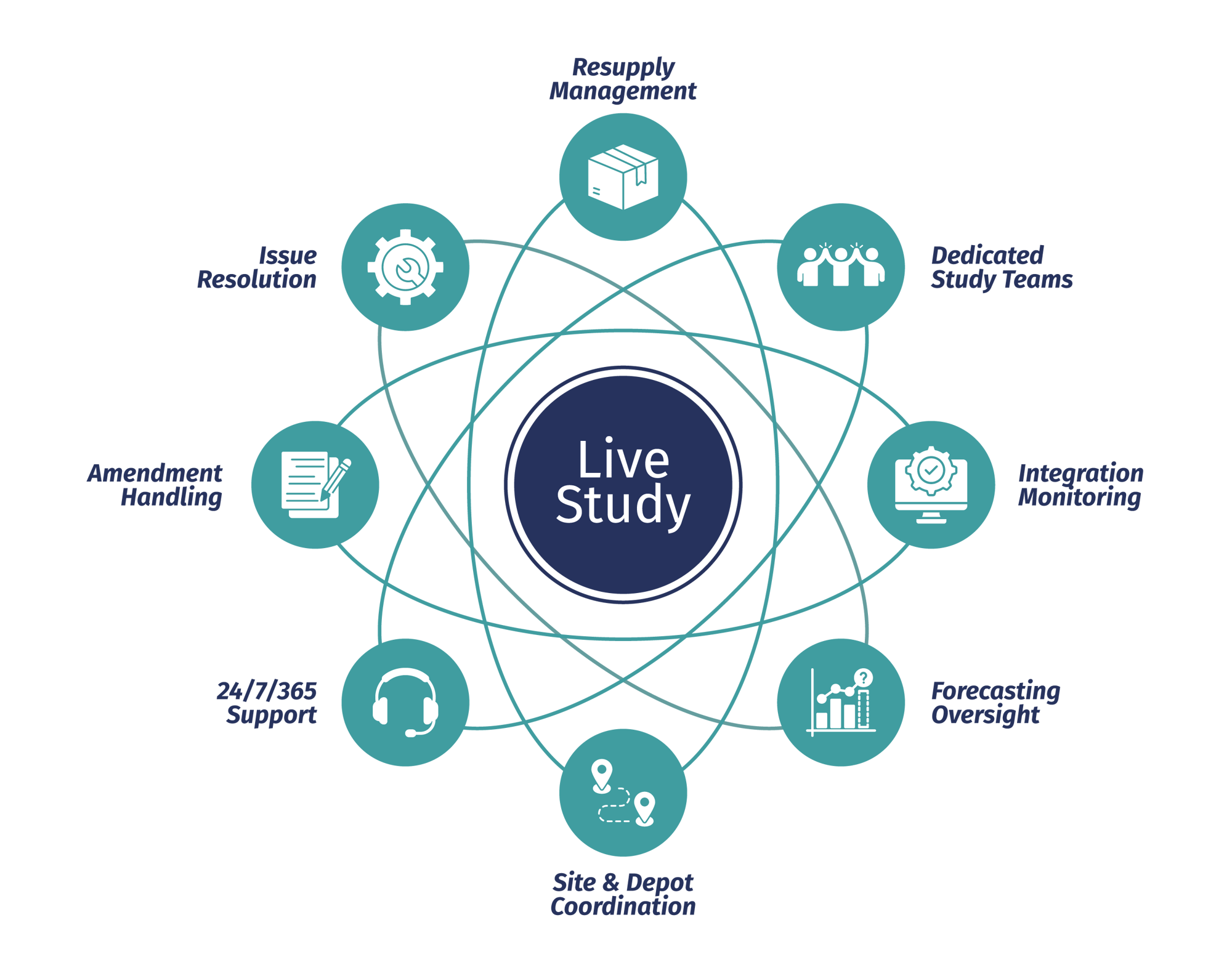
Go-live is not the end of delivery. Live study support requires sustained attention across supply, sites, systems, and change to help keep execution steady as the trial evolves. Continued operational support helps maintain continuity, respond to emerging needs, and keep the study aligned as conditions shift over time.
Client-Aligned Engagement
Services delivery at 4G Clinical is structured for sponsor and CRO teams supporting studies and programs across regions and evolving protocols. Sponsor operating models and internal expertise vary widely, so engagement, governance, and specialist support are aligned to how each organization works, scaling the right level of structure without adding burden.
Dedicated specialist roles span RTSM, forecasting, integrations, and amendments, with continuity from study kick off through closeout.
Delivery Model Value Drivers
-
Cross-study consistency through repeatable governance and delivery standards.
-
Forecasting oversight aligned to live study behavior through structured review.
-
Governed amendment delivery that protects dosing continuity and resupply behavior.
-
Integration continuity that preserves operational visibility and reporting integrity.
-
Reduced variability through clear ownership and disciplined change management.
-
Predictable delivery across regions and teams without unnecessary overhead.
Delivery Aligned to Sponsor Operation Models
4G Clinical services delivery processes are structured to fit distinct sponsor and CRO operating models, reflecting differences in internal expertise, governance expectations, and program demands.
The sections below outline the value drivers for biotech sponsors, CRO led programmes, and enterprise portfolios, and how specialist support and oversight are applied for each.
-
Biotech
-
Biotech Segment Value Drivers
-
Dedicated specialists engaged through build, maintenance, and study closeout.
-
Reduced sponsor burden through structured guidance and clear ownership.
-
Supply forecasting alignment that supports supply decisions without constant sponsor intervention.
-
Protocol to RTSM alignment that anticipates downstream amendments and evolving supply chains.
-
Governed amendment delivery that keeps dosing and resupply steady through change.
-
Transparent reporting and data visibility that supports confident oversight and decision-making.
-
Biotech organizations often operate with lean teams and limited in-house RTSM and clinical supply infrastructure while facing complex protocol requirements and tight timelines.
-
CRO
-
CRO Segment Value Drivers
-
Communication pathways aligned to CRO operating models, with clear roles and escalation routes.
-
Documentation standards that support sponsor confidence and audit readiness.
-
Amendment delivery mapped to CRO-led workflows, supported by dedicated amendment specialists.
-
Defined controls that reduce friction between system oversight and CRO operations.
-
Dedicated delivery teams experienced in CRO-led delivery models, supporting consistent coordination across stakeholders.
-
Mid-study change executed without disruption to governance, timelines, or accountability.
-
Flexibility in engagement without compromising discipline in execution.
-
Clinical Research Organizations operate within distinct governance frameworks and sponsor delivery models, often balancing multiple stakeholders across studies and programs.
-
Enterprise
-
Enterprise Segment Value Drivers
-
Dedicated account leadership that aligns to sponsor operating models, decision pathways, and stakeholder coordination.
-
Dedicated delivery teams that coordinate execution across programs, regions, and studies.
-
Sponsor specific standards and repeatable configuration that preserve consistency across studies, regions, and protocol versions.
-
Program-level governance and reporting that support consistent oversight across the portfolio.
-
Integration into enterprise data environments, designed for traceability and scale.
-
Dedicated amendment resources to implement portfolio-wide change within defined governance structures.
-
Enterprise sponsors require scalable delivery across global portfolios, with standardized processes, centralized oversight, and consistent execution across regions, teams, and therapeutic programs.
Explore our Solutions
Our randomization and trial supply solutions can easily be configured to include only the necessary functionality and are built to scale with you as your clinical program progresses.
Prancer RTSM®
Unifies randomization, supply management, and study oversight for more aligned trial execution.4C Supply® Forecasting
Forecasting, scenario modelling, and supply oversight aligned to changing study demand.
Integration Framework
Robust connectivity across trial systems, improving data flow, visibility, and continuity.
Expertise
Operational guidance and study design expertise to support more controlled, adaptable trial execution.Talk to Our Experts
Connect with 4G Clinical to discuss your study requirements, operational challenges, and technology needs.